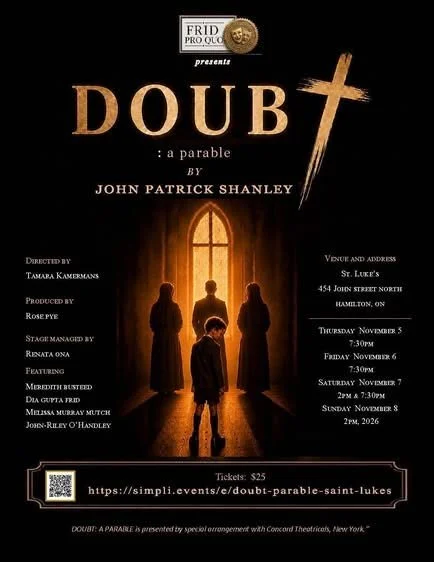
Doubt: A Parable is a morality play set in a Bronx Catholic school in 1964. The play focuses on Sister Aloysius’s suspicion that Father Flynn may have behaved inappropriately with a student and that those suspicions would have life-altering consequences if true. Written by John Patrick Shanley, the play premiered in 2004 and won the 2005 Pulitzer Prize for Drama and Tony Award for Best Play. A cinematic version was released in 2008 starring Meryl Streep, Amy Adams and Philip Seymour Hoffman. While there are many themes within Shanley’s play, perhaps the most interesting is the influence of doubt itself in a world of certainty. A powerful, contemplative drama, Hamilton based company Frid Pro Quo is staging the production in an actual church at the historical St. Luke’s Mission this November.
I had the pleasure of a virtual interview with director Tamara Kamermans and actor Meredith Busteed who will be portraying Sister James. Together, we discussed the inspiration for hosting the production at St. Luke’s, the complexity of the roles within the narrative and why morality plays are important.
Tamara - What inspired the company to stage “Doubt: A Parable” and host it at the historic St Luke’s Mission?
TK: Dia Gupta Frid had chosen it for her next project for Frid Pro Quo with a goal of having the performances in a church. She asked me to direct and we started to look at different churches but most seemed too large for the project. In the summer, I worked for the Fringe venue at St. Luke’s and I realized it had the perfect intimacy for the project.
Meredith - What inspired you to audition for the role of Sister James (or the play in general)?
MB: Dia Frid brought Doubt A Parable to me during the pandemic as a way to stay creative and connected during a difficult time. It was in those Zoom play readings that I fell in love with the writing. 6 years later Dia approached me again and asked if I would be interested in joining the cast as Sister James - this time in the same room! I gave the script another read and knew instantly that I had to do it.
I felt a kinship with Sister James, as I sympathized with, and recognized, a lot of her inner struggles to keep her warmth and kindness while questioning and understanding the world around her. The playwright describes Sister James as having a bit of sunshine in her heart, I believe this to be Sister James’ greatest strength, even amid a sea of doubt.
Tamara and Meredith - What have been some highlights and/or challenges in bringing this production to the stage?
TK: When working on an indie project the number one challenge is always space. Finding affordable space for rehearsal, finding affordable space for performance and in our case space to store the set and props overnight after each show. It’s a prayer to the theatre god’s endeavour. In this case, we cobbled together some rental space, some occasional library space and a kind donation of a colleague’s basement in the end. It’s scary because I’m used to the luxury of community theatre spaces and the great comfort they provide for the process. On the other hand, the experience has really bonded the troupe which makes for great connection with the work.
MB: The chance to work on this play, this production, with this team has been such a joy. As an actor, it’s a privilege to dive into this work, to do so with a team that cares greatly about the script while bringing so much energy and passion to every rehearsal is just the greatest gift.
Meredith- How does the nature of truth and uncertainty feature in this play and how has that affected the actors playing these complex roles?
MB: I believe Sister James is, in many ways, the embodiment of doubt. She begins the play certain in the people and the world around her, and quickly slides into a state of constant uncertainty, losing sleep, and questioning everything, even her own thoughts and beliefs. But if there was a silver lining (because I believe Sister James would look for one) it is that through her struggle she begins to discover her own voice, her truth, and her confidence.
Certainly as artists, and as humans, we’ve all faced moments of doubt; and returning to performing after some time away, I’ve had to deal with my own self-doubt and insecurities in taking on this role (but I, too, can think of a few silver linings in working through that!) So, maybe we’re not meant to be so certain.
Tamara - What makes staging morality plays such as “Doubt: A Parable” important to you?
TK: In the case of Doubt: A Parable, the important messages transcend time. The play forces you into moral consideration. You can’t take a sideline because the scenario is calling out for interpretation. Is she right? Did he do it? Was he wrong? Should she have? Who is a better person? It’s irresistible and it underlines that Doubt is necessary. Certainty, as Plato said, is ignorance because it implies to the self that there is nothing more to learn. What could be more important to our modern society than the message that we must think and doubt the world around us in order to find the truth? Certainty is dangerous in the modern day.
Thank you Tamara and Meredith for your insights into what makes Doubt: A Parable such a timeless and thought-provoking play. Go and support this award-winning drama coming to Hamilton’s St. Luke’s Mission November 5-8 ONLY.