PREVIEW: FOR WHAT WE LABOUR - A TRUE LABOUR OF LOVE… AND FARCE
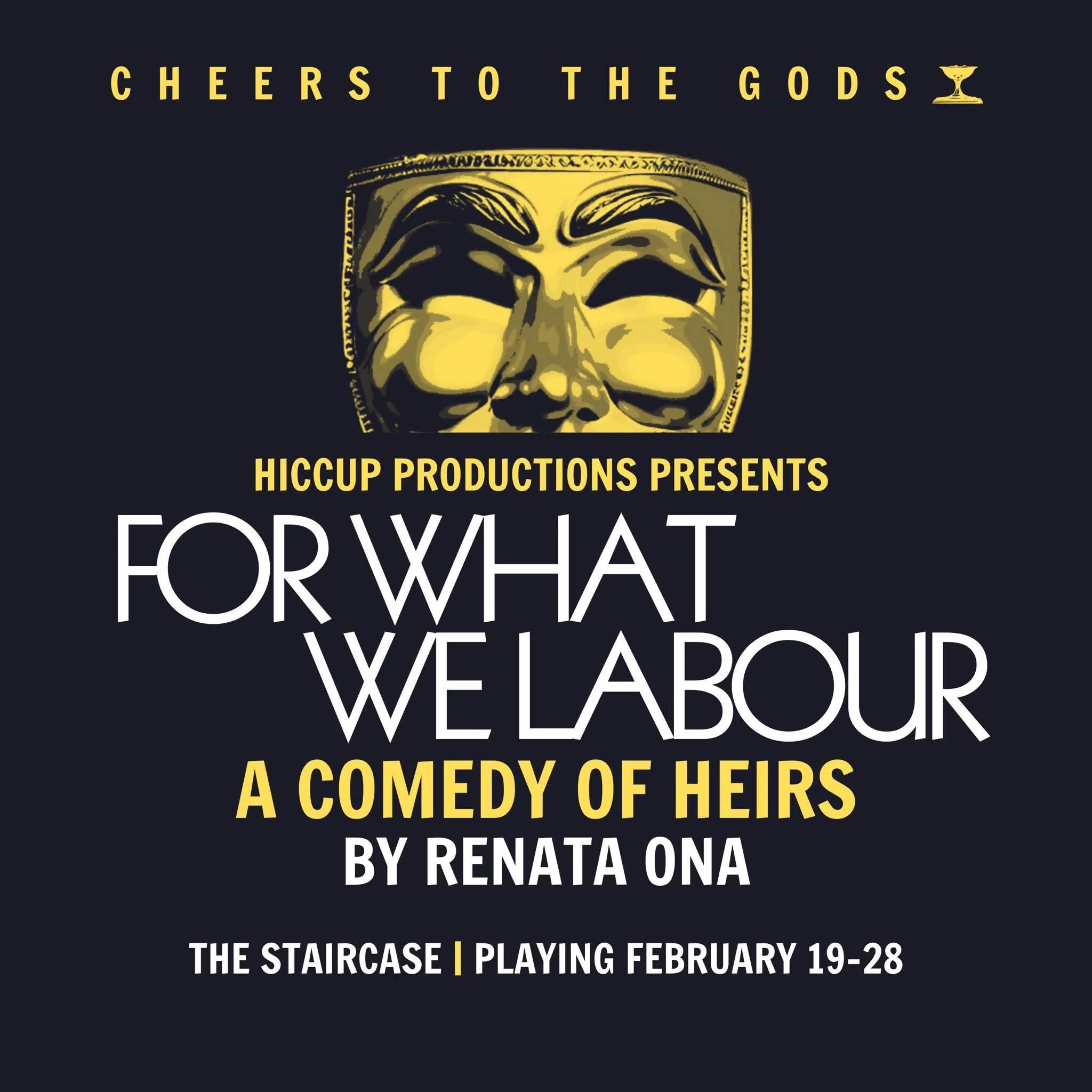
What happens when you combine mythology and farce? You get an enticing original work penned by Renata Ona, a Hamilton community theatre enthusiast, who is bringing her new work to The Staircase Studio Theatre this month.
Ona has been involved in several community theatre shows including Art of Murder with The Players Guild of Hamilton last October. I had the pleasure of a virtual interview with Ona and together we discuss her inspiration for writing For What We Labour, her writing process, the highlights and challenges of putting on an independent show in the community and what audiences can expect from this intriguing premise and its themes.
What inspired you to write For What We Labour, A Comedy of Heirs?
RO: For What We Labour was inspired by my desire to write a play from start to finish, and the idea came about after reading The Pot of Gold by Plautus. Its comedic and chaotic plot, based in Athens, sparked the idea. In it, a miser fakes being poor so no one steals his riches, but his gold is stolen anyway. The play mentions a pregnant daughter but we never hear her story as she’s neglected by the playwright. I felt a bit of outrage for stories that go untold and my imagination went wild. So, originally, For What We Labour was going to be called “Behind Closed Doors.” Doors are a theme in the plot still, as they create spaces between rooms where very different conversations are happening at the same time. And they facilitate surprises. Ultimately, the play turned out to be a farce comedy.
What do you like best about farce plays and what makes this type of comedy special to you and the cast?
RO: The high energy! I’ve noticed that the TV shows I rewatch again and again are farcical - Derry Girls, Schitt’s Creek, Brooklyn 99. They’re quick, witty, and the layered jokes are satisfying. But beyond that, farce creates a huge playground. It’s a fun challenge to push each situation to its silly limits and find the rhythm of the chaos. Plus, the cast has brilliantly interpreted For What We Labour’s characters and made each of them flamboyant in some way. We have so many great improvisers in the cast, that they’ve created little games and improvised moments, which is possible in this genre.
What have been some highlights of developing the show? What has been your favourite part of the process?
RO: The best part of developing For What We Labour is that it’s a product of a cool journey that spanned a year and a half. This journey helped me deeply feel others’ generosity and desire for connection. And like any journey worth talking about, it entailed interesting side quests.
During and after writing the first draft of For What We Labour, I took a hodge-podge of writing workshops, which connected me with experts in playwriting, characterization, and comedy. I read several plays for the first time since school required it, which provided tremendous insight. And I also got out into the community and did a bunch of acting, producing, and improv, so I was constantly around people and experiencing others’ art.
Many of these creatives were willing to take a moment from their own art to lend a hand and some were even open to joining someone else’s creative project! So overall, it was such a fascinating year, and I thank this idea very much for knocking on my mind-door and prompting me to go down this path.
What have been some challenges developing the show and how have you overcome them?
RO: One of the biggest challenges of developing For What We Labour is that I went into it very naively (which is probably also why it’s been produced at all). Producing a show at the Hamilton Fringe gave me experience but also a false sense of security. I was naive because I actually thought I had created a simple concept. Not so.
For What We Labour is an independent show (read: produced without the support of a Fringe Festival) with eight characters portrayed by eight humans with different skillsets – from professional actors, to new actors, to improvisers (true community theatre, I say!). There is a full set with three rooms on stage all at once, requiring skilled stagehands backstage and to create lighting and sound effects. Not to mention the costumes. My thinking was that I would produce and direct. The set would be bare bones. My mother sews. Surely someone knows lights and sound. We can figure it out. But who is we? Therein lies the true magic. For What We Labour has been a project of ongoing creativity and teamwork from everyone involved, especially in its later stages – its stage production. I deeply appreciate the cast and crew. Everyone has contributed in some way and that is true community theatre.
How will this production speak to audiences and what do you hope they take away from it?
RO: In addition to speaking to audiences in the language of comedy and sending them home with an hour’s worth of a good time, For What We Labour speaks the language of acceptance. Audiences will witness a world with a great capacity for diverse love and non-binaries, which prompts thoughts on the blended family. Character couples illustrate the chaos and diversity of real relationships - without judgement or shame.
But make no mistake: there are consequences. For example, an attempt to explore sexuality between a bi-curious woman and a bisexual man (this exploration happens in the past and is not shown on stage) results in an unplanned pregnancy, which is the focal point of the plot. This disrupts plans, sure, but there is no shame. And For What We Labour has so many moments like this. We hope you come to see it!
Thank you Renata for such an insightful discussion about your new play which is sure to delight audiences who enjoy myths and high energy farce comedy. This endeavour defines the spirit of community theatre and it is a labour of love that I hope Hamilton audiences will champion during its run. The show runs at The Staircase Studio Theatre February 19-28. Go and support original works by our Hamilton community playwrights!